GRINDER TALK · AN OLD ARGUMENT
Every few months someone asks if a blade grinder is fine for espresso. It is fine for cumin. It is fine for ending the conversation.
Short answer: no. Long answer: still no, but with reasons. Here are the reasons, so you can send this link and go back to your day.
What a blade grinder actually does
A blade grinder is a tiny propeller in a cup. It doesn’t grind to a size. It whacks beans until you let go of the button. CoffeeReview described the spinning blade as acting “more like a hammer than a scalpel.” There’s no telling how many times any one chunk of bean gets hit, so each hit sends out another random spray of particle sizes.
When CoffeeReview sent grounds to a lab for particle-size analysis, the popular blade grinder in the batch produced “the wildest variety of particles by far.” Their conclusion was a blanket recommendation against blade grinders for good coffee.
Even the espresso machine makers agree. Gaggia’s Classic Pro instructions say it is “preferable to use a grinder mill rather than a blade mill because the latter releases too much coffee powder and produces an irregularly ground blend.” That’s the machine company telling you, in writing, that the blade grinder is the problem.
A blade grinder doesn’t have a setting. It has a duration. Those are different things.
What a burr grinder does instead
A burr grinder feeds beans between two serrated surfaces, one spinning and one fixed. The gap between them sets the size. Turn the dial, the gap changes, the grind changes. Same setting tomorrow, roughly the same grind tomorrow. That repeatability is the whole point.
Why does uniform size matter? Water pulls flavor out of small particles faster than big ones. CoffeeReview’s explanation is the clearest we’ve read: the closer your particles are to the same size, the easier it is to control the flow of water, and so the extraction. A blade grinder hands you dust and boulders in the same scoop. The dust over-extracts toward bitter. The boulders under-extract toward sour. You get both, in one cup, for free.
Why espresso makes it worse
Espresso pushes water through a tightly packed puck at about 9 bar. That’s what the Bambino Plus and the Gaggia Classic Pro (E24) both list. Breville’s own manual explains what happens at the extremes: too fine and the water won’t flow, too coarse and it gushes. Now imagine a grind that is too fine and too coarse at the same time. That’s a blade grinder’s whole personality.
This is also why pressurized “dual wall” baskets exist. Breville says they regulate pressure regardless of grind and freshness. They can make a blade-ground or pre-ground shot look presentable. They can’t make it taste like a dialed-in one.
The fair part
Is a blade grinder useless? No. CoffeeReview says it’s still better than buying pre-ground coffee. If you make French press on a budget, fine. Live your life. We are only mean to blade grinders when they’re pointed at an espresso machine.
If you already own one, don’t feel bad. Most of us started there. It was cheap, it was loud, and it got us into this mess. Just don’t build an espresso setup on top of it.
The second argument, which we’re also tired of
Then someone says, “OK, but conical or flat burrs?” CoffeeReview’s answer for affordable home grinders: the difference is “more theoretical than actual.” Neither shape wins by default at this price. Pick the grinder by whether it can do espresso well, not by the shape of its teeth.
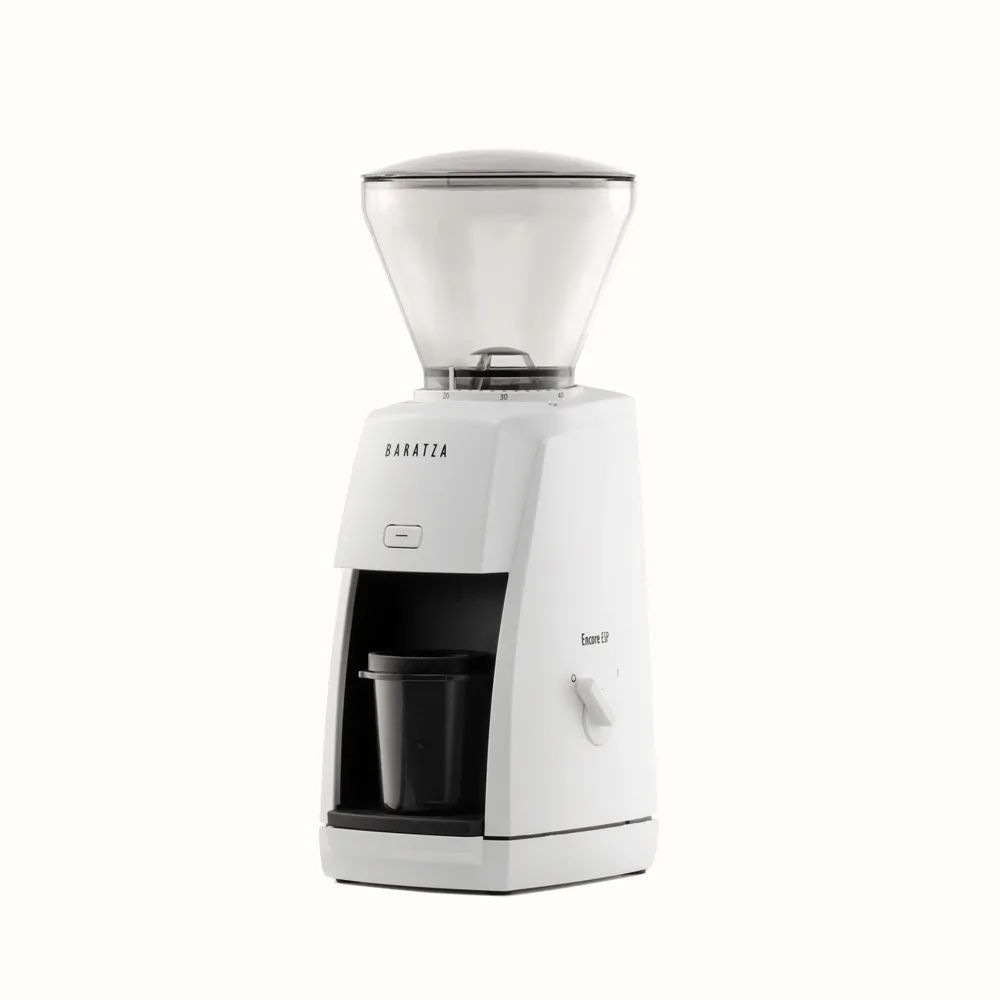
And note the trap: a burr grinder isn’t automatically an espresso grinder. It needs to reach a fine enough grind and step through that range in small increments. The Encore ESP gives half its 40 settings (1 to 20) to fine, small-step espresso grinding. The Sette 270 pairs macro steps with a stepless micro adjust. Those are designs built around espresso. A drip grinder with three “fine” clicks isn’t.
We may earn a commission if you buy through our links, at no extra cost to you. How that works.
Basis: manufacturer specs and manuals, the references linked below, and price. We have not run this gear through our own testing, and we won’t pretend otherwise.
Sources
- CoffeeReview: Mid-range burr grinder equipment report (2020)
- Gaggia: Classic Pro operating instructions, US (PDF)
- Gaggia North America: Classic Pro E24 product page
- Breville: Bambino Plus product page
- Breville: Bambino Plus instruction booklet (PDF)
- Baratza: Encore ESP product page
- Baratza: Encore ESP operations manual (PDF)
- Baratza: Sette 270 product page
Leave a Reply